

Top Pensacola Tech Companies: A Cybersecurity Readiness Guide
October 2, 2026
What Are Managed IT Services? A Practical Guide To Smoother Daily Operations
October 31, 2026IT Careers In Pensacola: A Practical Roadmap For Skills, Security, And Growth


Table of Contents
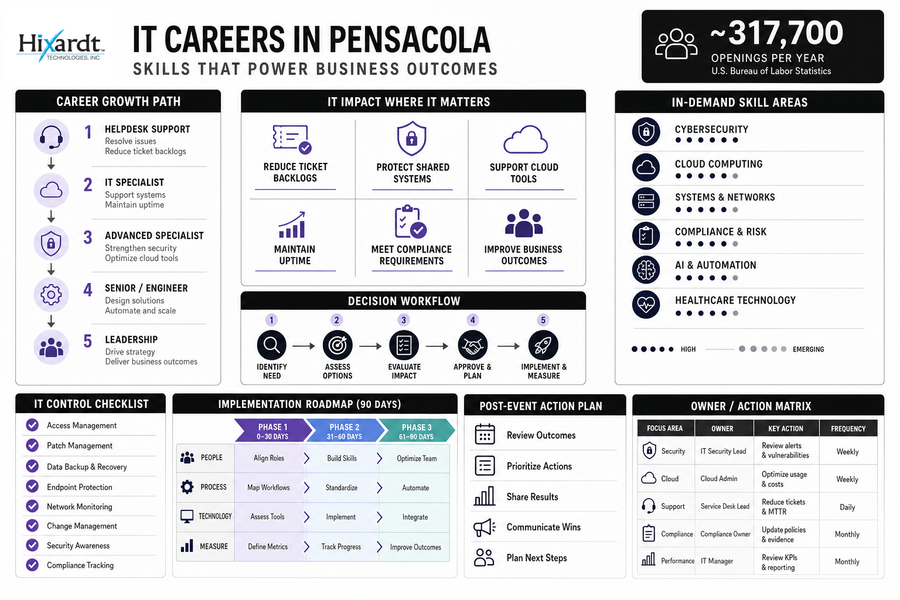
Local organizations need IT workers who can reduce ticket backlogs and protect shared systems. They also need people who can support cloud tools, maintain uptime, and understand compliance pressure. That makes IT careers in Pensacola a practical path for people who want their work tied to visible business outcomes.
The U.S. Bureau of Labor Statistics expects about 317,700 openings per year in computer and information technology roles. Career growth often begins with dependable helpdesk work. From there, it can expand into cybersecurity, cloud, and compliance. AI automation and healthcare technology support may follow as skills mature.
Michael E Hicks Jr, President-CEO at Hixardt Technologies, notes: “Strong IT careers start with reliable service habits because every password reset, access change, and ticket note affects someone else’s ability to work safely.”
IT Careers In Pensacola Start With Operational Reliability
The first step to IT that promotes growth isn’t just fixing computers. A helpdesk technician may handle password resets, printer issues, Microsoft 365 access, and urgent user tickets before lunch. Each task affects schedules, customer calls, and access to charts. It can also affect invoices, approvals, and handoffs.
Key examples of the value of IT support personnel:
-
Password reset control: Verifying identity protects accounts while getting users back to work.
-
Ticket triage discipline: Clear priorities help urgent issues reach the right person.
-
Access request handling: Good approvals reduce delays and limit unnecessary permissions.
-
Audit-ready notes: Complete records support reviews, handoffs, and incident follow-up.
Seemingly entry-level IT roles enable the development of essential skills and habits into a solid foundation for higher-trust roles because reliability, documentation, and escalation discipline show up in every ticket.
Pensacola Tech Schools: Evaluate Them By Career Fit
Training choices should be judged by job readiness, not course names alone. Pensacola tech schools should be evaluated for hands-on labs, ticketing practice, networking basics, and security fundamentals. They should also build Microsoft 365 exposure, documentation habits, and learning that reflects employer needs.
That practical proof matters. ISACA reported that 88 percent of respondents view credentials as important, while 66 percent view a university degree as important.
Useful training should put learners near real support conditions. Examples include locked-out users waiting for access, device imaging that must be done correctly, and email filtering that affects customer messages. Access requests may need approval, and incomplete ticket notes may need correction before escalation.
IT Education Options In Pensacola Need A Skills Roadmap
A clear education roadmap keeps training from becoming scattered. IT education options in Pensacola should connect early support work to later specialties, especially as the cybersecurity workforce shortage is estimated at 4.8 million.
Good educational and career planning aligns with building an IT career that is long-lasting, lucrative, and rewarding.
|
Priority |
Business Impact |
IT Control |
|---|---|---|
|
User support |
Faster service response |
Ticket triage |
|
Endpoint management |
Fewer device delays |
Imaging and patching |
|
Identity and access |
Safer approvals |
Role-based access |
|
Cybersecurity awareness |
Lower user risk |
Phishing coaching |
|
Compliance evidence |
Cleaner reviews |
Policy records |
|
Cloud administration |
Better uptime |
Microsoft 365 controls |
Explore Pensacola’s Tech Landscape
Cybersecurity Bootcamps In Pensacola Should Connect To Daily Risk
Cybersecurity training should prepare learners to reduce operating risk, not just memorize tools. Cybersecurity bootcamps in Pensacola should teach phishing response, endpoint protection, patch follow-up, and vulnerability tracking. They should also cover incident notes, access reviews, and user coaching.
The need is clear. The global cybersecurity workforce is short by 4.8 million people, while 95% of organizations report skills gaps and 59% face critical or significant shortages.
Training should move learners toward repeatable security work with clear ownership and usable notes. Endpoint protection, vulnerability management, identity controls, and incident response turn classroom knowledge into daily risk reduction.
College IT Programs In Pensacola Can Build Long Term Depth
Longer academic paths can support movement into systems administration, cybersecurity analysis, and cloud operations. They can also support compliance coordination, healthcare technology, and IT leadership. College IT programs in Pensacola should also reflect that tech roles sit across the economy, with 40% in technology companies and 60% in other sectors.
Examples of this idea are:
-
Stronger troubleshooting discipline: Students learn to isolate root causes before replacing devices or escalating tickets.
-
Better documentation habits: Clear notes support audits, handoffs, and repeatable service.
-
Security and compliance awareness: Regulated healthcare, legal, and government support depends on careful evidence.
-
Cloud and infrastructure knowledge: Reliable Microsoft 365, identity, and backup practices support uptime and safer collaboration.
-
Communication with nontechnical teams: Good IT workers explain risk in plain business terms during urgent support moments.
Depth turns technical knowledge into sound judgment teams can trust under pressure.
Build Skills for Real IT Operations
See how Hixardt Technologies helps Pensacola teams strengthen support, security, and compliance readiness.
IT Programs In Pensacola Should Prepare Workers For Regulated Environments
Many IT roles require more than technical skill. IT programs in Pensacola should prepare workers for environments where evidence, policies, and access controls affect daily service. Uptime and clear reporting matter too. A healthcare workflow, nonprofit donor system, finance file share, or field service dispatch board all depend on accurate access and stable systems.
This matters because 21% of mid-sized organizations report a security skills gap in their IT departments. Regulated work also values disciplined documentation, clear escalation paths, and careful handling of customer systems and data.
Information Technology Colleges In Pensacola Are Only One Part Of Career Growth
Formal education helps, but trusted work habits complete the picture. Information technology colleges in Pensacola can provide structure, while career changers still have to balance time, cost, confidence, and work responsibilities. Moving from helpdesk into cybersecurity or cloud roles takes steady practice.
Key examples of this include:
-
Build a home lab: Practice users, groups, virtual machines, and basic network services.
-
Document support work: Turn daily fixes into clear notes and repeatable steps.
-
Practice security basics: Review phishing, patching, backups, and access controls.
-
Seek experienced feedback: Ask senior IT staff to review tickets and escalation notes.
Employers notice candidates who learn consistently, document responsibly, and communicate clearly when users need help.
A Practical Path Forward
An IT career grows through reliable support habits, security awareness, and compliance discipline. Cloud understanding and clear communication with users are also essential.
Hixardt Technologies is a small business founded in 2001 by three Navy veterans, with over 25 years of experience in mission-focused technology partnership. The company supports managed IT, cybersecurity, and compliance. Its teams also support cloud and AI automation. Secure healthcare technology, Pen Testing, and consulting are delivered through a U.S.-based and vetted W2 workforce. That mission-focused approach connects the ticket, the access request, and the security decision back to operational control.